What You Will Not Find Here

You will find no advertising, no pop-ups, no tweets. Not even photographs, let alone a slide show. Nothing here will be moving fast. It will hardly be moving at all. Visit when you want a break from frenzy.

Saturday, June 30, 2012

Day 23 Outdoors: Old Chicken House

Friday morning, June 29, 2012, 6-7 a.m.

It is a breezy, clear morning of what promises to be another warm, sunny day. The birdsong chorus is not as riotous as it was a month ago. Birds are still singing, but not as many of them and not as insistently. Mornings are calmer by the end of June.

The old chicken house sits to the south of the popple grove (popples, not kept in check, edging farther and farther out into the meadow), largely in shade most of the day. On the first farms in this part of Michigan, in the old days all the buildings were sided with cedar shakes. Houses, barns, granaries. Fish shanties and boathouses, too. White pine timber was cut and shipped to cities for building purposes; cedar, strong and plentiful, splitting easily into shingles and with oils that repelled insects, as well, was the local building material. There are many 100-year-old cedar shakes still at work in Leelanau County.

Unpainted shingles weather from light, bright brown to warm, deep tones and then to dark or grey over the years, depending on the direction of exposure to the sun and amount of roof overhang and shade. On the west face of this old chicken house, the shingles are darker the lower down their position on the wall. Many are streaked from weathering or dotted with holes from predations of birds and insects. The doors, one on the east end and another on the west, are made of plain boards, and there is a square-framed, boarded-over opening up high in the west wall with a screened triangular opening in its center, doubtless for ventilation. The door is fastened with simple hinges and simple lock. At the peak of the eaves are remnants of the old electric line and exterior light fixture. Alongside the end of the building is an old aluminum boat on a rack.


Cooing of mourning doves sounds from deep in the big barn. As the sun rises higher over the eastern woods, light falls through the popples onto the north wall of the chicken house, and individual popple leaves in the grove are backlit, their margins edged with gold. These leaves rustle ceaselessly in the morning breeze.

Tuesday, June 19, 2012

Day 22 Ourdoors: Clouds and Wind


Monday morning, June 18, 2010, 5:50-6:45 a.m.

Dawn comes in the east, but light wells from all directions, incipient sunrise tinting clouds to the west as well as the east. A feel of coming thunder is in the air. Clouds are now rippled silk, now shredded gauze, until finally a uniform, featureless screen prevails over meadow, woods, and orchards as clouds from the west merge with those in the east, and all homogenize.

Wind is from the west, bringing weather from over Lake Michigan. The wind brings some sounds closer and blows others away. Rustling leaves, calling birds—the soundscape forms layers, both vertical and horizontal, like the compressed visual layers through binoculars or an old-fashioned stereopticon. Sound layers up from the ground and away toward the horizons. There is a perfume in the air, too. What is it? Black locust are finished blooming, basswood not yet in blossom.

Popple trees, like their human counterparts, with nothing to say, whisper ceaselessly. Clouds remain silent. Clouds are in their world, popples in theirs.

To the southwest, a brief coyote commotion breaks out. Willow leaves seem to turn inside out in the wind.

Raindrops.

Day 21 Outdoors: A Long, New View and More Horses


Friday morning, June 15, 2010

When an old orchard is wrenched out by the roots, new views break wide open. From Novotny Road this summer, where a damaging early spring storm made replacing large blocks of trees a priority, suddenly the prospect to the west and north encompasses a series of hills, North Lake Leelanau, more hills, wide, cool Lake Michigan, and North Manitou Island. Tractors are busy this morning on the old orchard land, filling the brisk wind with sweet-smelling dust. Old trees bulldozed into bonfire-sized piles await better burning weather, while for now the tractors work to cultivate the open land around the giant brush piles, and, with front-end loaders, remove boulders brought up by the old tree roots, piling them at land and road corners. Gulls come eagerly to forage in the freshly turned earth. Beep-beep-beep goes the tractor, backing up.

A couple of Friesian horses graze contentedly in a nearby pasture, their burnished coats warm in color, sheen of light gleaming on their haunches. Ears flick, tails swish. Between orchard and pasture a row of mature cottonwoods rustles continuously. Everything is in calm motion, some but not all of it purposeful. A monarch, for example, half-flutters by, tumbled in the wind. 

Leaves rustle, gulls cry.

Along the pasture fence blooms bladder campion, petals and stamens reaching out from each open-ended, balloon-like, almost translucent, veined calyx. It is only a weed, but its numbers are legion, and each individual plant is as much a miracle of intricacy as the bodies of the horses in the pasture.


Thursday, June 7, 2012

Day 20 Outdoors: Back in the Popple Grove

Wednesday, June 6, 7:40-8:20 a.m.


The difference from February to June is breath-taking, even in this tiny, insignificant bit of semi-wild ground. Four months ago silence blanketed the grove. This morning all manner of sounds ring under the bell of the sky, as if a glass globe encompassed the earth. Foremost and most immediate are the morning birdsongs, almost "noisy" but in the loveliest of ways, with the steady sound of an orchard sprayer in the background and intermittent, distant sounds of traffic. 

A soft breeze plays through the grove, rustling the popple leaves and making them dance. Sunlight filters in, first very low and gradually moving up the grey-green trunks. Grasses sway gently. 

"Morning has broken/like the first morning."


Friday, June 1, 2012

Day 19 Outdoors: Visiting Horses on Jelinek Road

Thursday, May 31, 7:30-8:30 a.m.


The morning air is autumn-cool after an overnight temperature drop, but the grass sports dew, not frost. Gentle grey clouds in the east echo multiple curved horizons, layered like time in rock, advancing from east to west—thickly clustered trees, then a field, a row of wild shrubs, another field, a fence, and finally, closest to the road, the horse pasture. Metal posts stand out clearly, but thin wire’s near-invisibility creates the illusion that the horses remain where they are by choice. Their pasture is large and green, however, and they are free to return to the corral (gate open) as they please for long draughts of water.

Sounds come from gulls, crows, mourning doves, sparrows and songbirds, as well as from a tractor somewhere nearby but out of sight, no doubt spraying orchard trees. The three horses move continuously but at a leisurely pace, heads down to graze most of the time. The sound of their constantly working teeth and jaws does not carry to the road. Perhaps the breeze carries it away. The air eddies in small currents, undecided on a firm direction. The horses’ heads are large and sweet, hindquarters muscular and patient, bilateral symmetry familiar and endearing, contour lines like ancient antelope. The heady smell of them is deep in memory. 


The old barn was probably built one section at a time, beginning with the old two-story part on its solid stone foundation. Additions abound, roof slopes complicate, and weathered boards are in good shape. With big barn doors closed, the horses can still take shelter under a shed roof. There the sun will still reach in from the south, and the stone foundation will reflect the sun’s warmth.

These horses have a good life. 

Wednesday, May 23, 2012

Day 18 Outdoors: Meadow at Daybreak


Wednesday, May 23, 5:50 - 7:00 a.m.

Before daylight the bird chorus began. There is a bank of cloud on the horizon to the east, dark, but low enough that the sun will clear it only slightly later than its light would otherwise reach the meadow. Near the ground cool air stirs gently. It is a morning for looking, watching, seeing; for listening and hearing; for feeling the air in all its subtle movement. For being here.

The meadow was a hayfield for a long time. One summer a decade or more ago it was a cornfield, but since then it has simply been a meadow. It is uncultivated but somewhat managed. One corner seeded with native wildflowers, a strip seeded with native grasses, it is bordered on two sides by young orchard, on one side by wooded bank above the no-name creek, and the fourth side by old farmyard and popple grove. The autumn olive is kept at bay by persistent effort. The meadow was mowed last year, in early summer, but nature wants it to be woods again. Deep-rooted alfalfa, dark green and healthy, persists in spotty clumps through the grass, as do last year’s dry goldenrod, milkweed, and Queen Anne’s lace, but there are also, far out from the more recently seeded areas, wild grapevine, clumps of red osier, and seedlings of maple, black walnut, and box elder. Once in a while a pine seedling appears.

Sounds sort themselves out spatially: rooster to southwest, woodpecker to the east, crows off in the distant south, traffic to the west. Nearer, in the silver maples of the farmyard, robins sing. After a while, though, all other sounds become background to one nearby chik-chik-chik. A very plain sound. The sparrow uttering the dry note perches on a brittle stalk of last year’s milkweed and balances with continual small adjustments, so that any still photograph or drawing of this little bird would be false. Its tail and wings flick constantly, and the bird itself looks about and changes position incessantly, never still for two consecutive moments. Streaky chest, black breast patch. A song sparrow but only giving its repetitive call note. Too early for singing?

Light increases, reaches higher, the dark cloudbank giving way to diffuse, trailing scarves. As at dusk, the cool air rises from the ground, and the breeze gains momentum with the rising sun, as if eager to be in motion after the stillness of night.

Another small bird on another dry milkweed, this one surprisingly more musical than the song sparrow, keeps its head tucked down between choruses but stretches its head, beak upward, to trill its song. These birds have no idea how tiny they are and how big the world is, but the world of this small meadow is all-sufficient to the break of day--the cool morning air, a clump of young black walnut, a nervously twitching sparrow, another bird’s throaty, trilling song, and the clouds evaporating by degrees as the sun clears the tops of the trees.


Sunday, May 13, 2012

Day 17 Outdoors: Old Dairy Barn

Saturday, May 12, 7:30-8:35 p.m.

(The title of this post has been changed.)

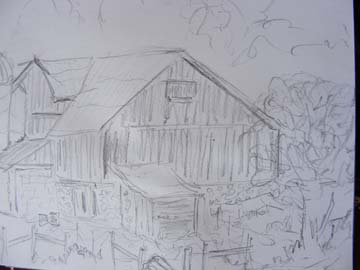
When farmhouse and barn were new, the house sat high on the hill, and the barn was in the backyard, but since the house was moved downhill, their respective positions have been reversed. This view of the barn is from the west, as the farmer would have approached it in the old days to milk cows morning and evening. The barn would not, however, have been as dilapidated then as it is today, no longer housing livestock. The tall and massive section was originally roofed with wood shingles. Later, sections of metal roofing were laid on over the shingles, but on half of the western slope of the roof the metal is gone, and the shingles have been deteriorating rapidly. Old boards curve and sag inward. Gaping holes appear. Framing and side walls (of vertical boards) are in better condition.


Cows were kept in the shed on the north end of the barn. Inside, troughs in the concrete floor of this section received their body waste. There was a door between the two sections so that old Joe could transfer bales of hay and straw—the latter their bedding, former their winter food when pasture was snow covered—to their stalls. At either end of the tall section of barn are doors high in the walls where the last bales would have been delivered to the tops of the mountains inside by elevator.

The cowshed walls were simple boards laid horizontally, but at some point in the barn’s history these had been overlaid with sheets of stamped metal. Now, all these years later, much of the stamped metal has been peeled back and torn off by wind rushing down the hill, so that sections of old board are exposed. One small window is boarded shut, as is the small door on this side, while the other window is opaque silver-grey with the grime of decades.

The east side of the barn is kept mowed, but the west face
has been ungroomed for many years. Weeds and large shrubs grow up against the large old doors (not seen here) where machinery and wagons could once go in this side and out the other. This barn was built by a Bohemian farmer and shows his saving ways. Its decay shows the history of farming in Leelanau County: as livestock declined and orchards came to predominate, the old hay barns were no longer needed and not kept in repair. This one was also built without a foundation, its old twisted cedar uprights, seemingly as strong as iron, set directly on the ground, so over the years the barn has settled more and more, wanting to lie down and return to earth.


Late evening sun, soon to set behind the hill, warms the wood. The light changes almost by the moment. The lower its angle, the more detail appears: wood grain, knotholes, the subtle shading that weathering has brought about.

Sparrows flit in the shrubs. Mourning doves call.